Endurant vs. Perdurant
The thing that exists at a time vs. the process that unfolds over time
Summary
Use endurant for the thing that exists at a time, and perdurant for the process, event, or history that unfolds over time.
In ontology terms, an endurant is an entity that is wholly present whenever it exists. A perdurant is an entity that unfolds through time and therefore has temporal parts or phases rather than being wholly present at any one instant.
(Note: If you are French, or speak another Romance language where endurant and perdurant already sound like they ought to mean something, this may start to feel almost too semantic. Fair enough. But this is not just wordplay. Some serious ontology people really did adopt these as technical terms. Here, they name a specific distinction between entities that are wholly present at a time and entities that unfold through time.)
Other Names You May Hear
Different modeling traditions use different words for roughly similar ideas. The mapping is not exact, but it helps orient readers:
| Ontology term | Roughly similar names |
|---|---|
| Endurant | continuant in BFO, or everyday modeling terms like thing, entity, object, asset, or resource |
| Perdurant | occurrent in BFO, or terms like process, activity, occurrence, workflow, or episode |
| Transition event | domain event, state change event, or status change |
| Event history | event log, audit trail, or event stream |
| State | status, condition, or mode |
If you come from EventStorming or event-driven design, the easiest mental model is:
- the enduring business thing is the endurant
- the process unfolding over time is the perdurant
- the orange sticky-style business event is usually an event or transition event
Diagram
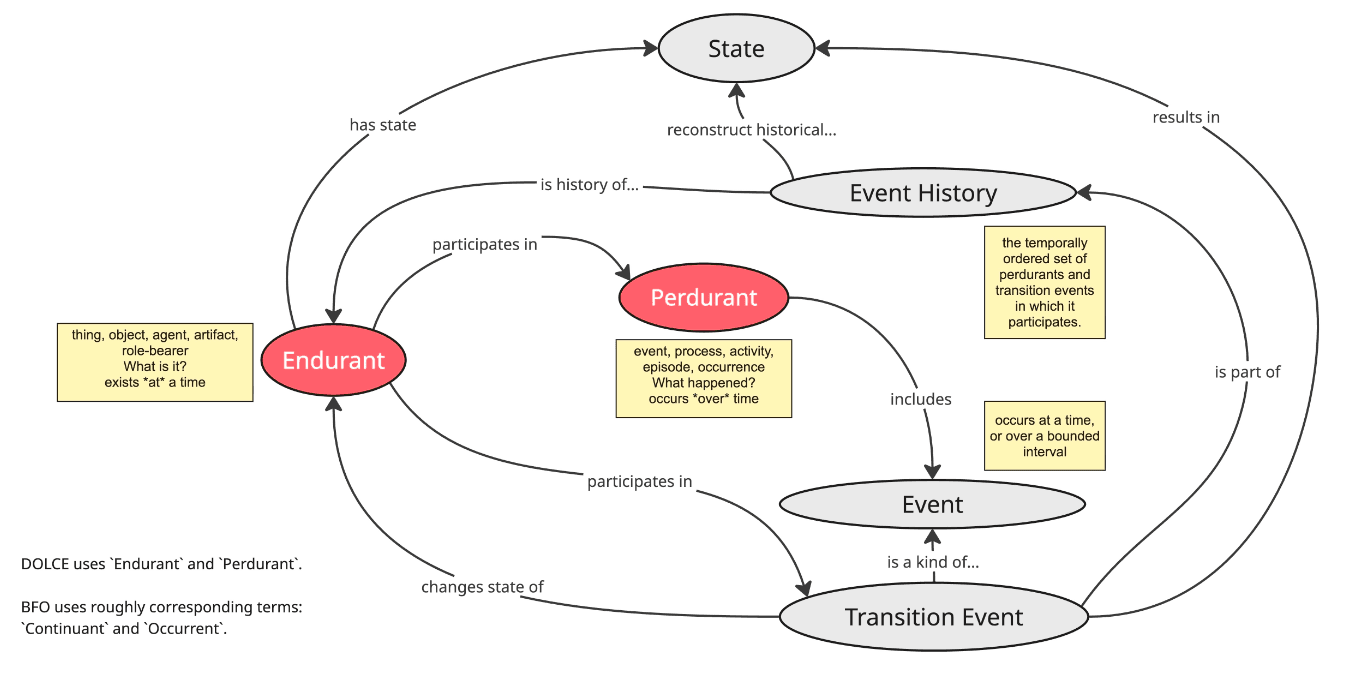
Operational Difference
Use this test when modeling:
- If you can take a time-slice or snapshot and still say "the whole thing is here now," model it as an endurant.
- If the thing only exists by happening over an interval and can be divided into before/during/after, stages, or episodes, model it as a perdurant.
In Practical Modeling Terms
Endurant
An endurant is usually a thing, object, agent, artifact, or role-bearer. It is the kind of entity you can point to at a given moment, even if some of its properties change over time.
- It persists through time while remaining the same entity.
- It may change properties over time.
- It participates in events and processes, but is not itself the event or process.
- It is typically modeled as something you can identify at a given moment.
Examples:
- a person
- a forklift
- a warehouse
- a contract document
- a customer account
Perdurant
A perdurant is usually an event, process, activity, episode, or occurrence. It is the kind of entity that only makes sense as something unfolding through time.
- It happens over time.
- It has temporal extent: a start, duration, and often an end.
- It can often be decomposed into phases, steps, or sub-events.
- Other entities participate in it.
Examples:
- a delivery
- a maintenance visit
- a hiring process
- a customer support call
- a system outage
Short Rule of Thumb
- Endurant: "What is it?"
- Perdurant: "What happens?"
Or:
- Endurant: exists at a time.
- Perdurant: occurs over time.
Example Pair
Technician= endurantRepair job= perdurant
The technician is wholly present at each time at which the technician exists. The repair job is not wholly present at a single instant; it unfolds across diagnosis, parts replacement, testing, and completion.
Events, States, and Transitions
It is useful to distinguish the enduring thing from the events that affect it, because many modeling mistakes come from treating the entity and its unfolding history as if they were the same kind of thing.
- The endurant is the entity that has properties or states.
- The perdurant is the larger activity, process, or history unfolding over time.
- An event is a bounded occurrence within that history.
- A transition event is an event that changes the state of an endurant.
Manufacturing Example
CNC machine= endurantProduction run= perdurantMachine status change= event, more specifically a transition eventIdle,Running,Stopped,Maintenance= states or status values of the machine
So the machine exists at a time, the production run unfolds over time, and the status change occurs at a specific time or over a very short interval. That distinction is what lets the model separate the thing being tracked from the change that happened to it.
Practical Modeling Rule
When something "changes at a certain time", do not treat the change itself as a property. Treat it as an event that results in a new property value, so the model can preserve both the current state and the transition that produced it.
For example:
- before the event, the machine has status
Idle - the
MachineStatusChangeEventoccurs - after the event, the machine has status
Running
This lets you represent:
- when the change became effective
- what the old value was
- what the new value is
- who made the change
- why the change happened
Useful Terms
Depending on how formal or business-oriented you want to be, the "actual thing that happens" can be named in several different ways:
eventsub-eventoccurrencestate change eventtransition event
In most operational models, state change event or transition event is the clearest term for a point-like change such as a status update, because those labels emphasize that something happened and that it changed the state of an enduring thing.
Ontology Mapping
In common foundational ontologies:
- DOLCE uses
EndurantandPerdurant. - BFO uses roughly corresponding terms:
ContinuantandOccurrent.
Why This Matters Operationally
If you confuse the two, your model tends to blur:
- stable entities vs. time-bound activities
- participants vs. the events they participate in
- object attributes vs. process states
That usually leads to poor queries, unclear event histories, and hard-to-maintain schemas, because the model stops distinguishing stable entities from the events and processes they participate in.
Try This Now
- Write down one thing in your organization that passes the endurant test: you can point to it at a moment in time and still say "the whole thing is here."
- Then write down one thing your organization talks about as if it were a thing, but that really makes more sense as something unfolding over time.
- Ask: what gets distorted when we treat the second one like the first?