Noun Farming
Extracting the real language of your organization
A lot of what we do at Dotwork is try to make your organization more legible without overwhelming people with all the complexity or enforcing language that doesn't match local needs. We are proponents of “minimally viable consistency,” which means considering the key things that must be made consistent across the organization and then letting different parts of the org interface with those concepts and maintain their own local language.
Part of Dotwork is establishing this common language. To that end, we do a lot of “noun farming,” which basically amounts to extracting the language you use in your organization. We also do “verb farming” to understand your various activities.
The best approach we've found is not to approach this from an ivory tower, wordsmithing angle, but rather to simply observe and listen to the words you use and catalog them with your best guess at the current meaning. Anyone who has done this understands that it is very, very common for definitions to be malleable, contextual, and squishy. That is completely OK.
Approach
- Rapid, unfiltered brainstorming of common nouns — Generate an unfiltered list of common “nouns” used in your organization. Ground these in what people actually say. You will end up with things like “Initiatives,” “Pillars,” “CEO 5,” “Epics,” “Tasks,” “Tribes,” “Work Groups.”
- Combine clear duplicates — It is common to generate 100+ items when a couple of people participate, so combine anything that is obviously the same concept.
- Have a brief conversation about each item — For each noun, clarify the following information. It is completely fine for different people to have different perspectives.
Noun Farming Definition Table
| Area | Description | Example Responses |
|---|---|---|
| Name | The name of the "thing." Capture the actual term people use. | "Initiative", "Pillar", "CEO 5", "Epic", "Workstream", "Experiment" |
| Meaning | Capture different perspectives on what it refers to. Squishiness is expected. | "An Initiative is a medium-sized chunk of work." / "A Pillar is a long-term strategic focus area." |
| Usage | Capture actual examples of how people use the term in practice. | "We say 'this Initiative rolls up to Pillar 2.'" / "Teams ask for Epic IDs to track dependencies." |
| Lifecycle | How does this thing come to be? Who creates it? What stages does it go through? | "Created during quarterly planning." / "Owned by the PM." / "Lives for 3–6 months, then archived." |
| Relationships | How does this item relate to others? Represent relationships explicitly. | "Initiative — contributes to — Objective." / "Epic — depends on — API Migration." |
| Health and Usage | Are these things core and always up to date? Rarely used? Politically sensitive? | "Initiatives are up to date weekly." / "Pillars are vague and rarely referenced." |
Example: “Initiative”
| Area | Example (Filled In) |
|---|---|
| Name | Initiative |
| Meaning | Different people use "Initiative" to mean a medium-sized chunk of work that drives progress toward a bigger strategic outcome. Some leaders describe it as "the stuff we commit to this quarter," while some teams treat it as "anything bigger than a story but smaller than a project." There is some fuzziness around whether an Initiative is tied to OKRs or can exist independently. |
| Usage | People often say things like: "This Initiative ladders up to Pillar 2," "What Initiatives are blocked by Legal?", or "We need to update the Initiative status before the QBR." |
| Lifecycle | Initiatives usually originate during quarterly planning. PMs or functional leads draft them, and Directors review and approve the set. They move through informal stages like "Draft," "Evaluate," "Planned," "In Progress," "On Hold," and "Complete." |
| Relationships | Initiative → composed of → Epics. Initiative → supported by → Metrics. Initiative ← dependent on ← Compliance Review. |
| Health and Usage | Initiatives are widely referenced and usually up to date within the PM org. However, updates tend to lag when cross-functional teams are involved. Leadership heavily relies on Initiative status during QBRs. |
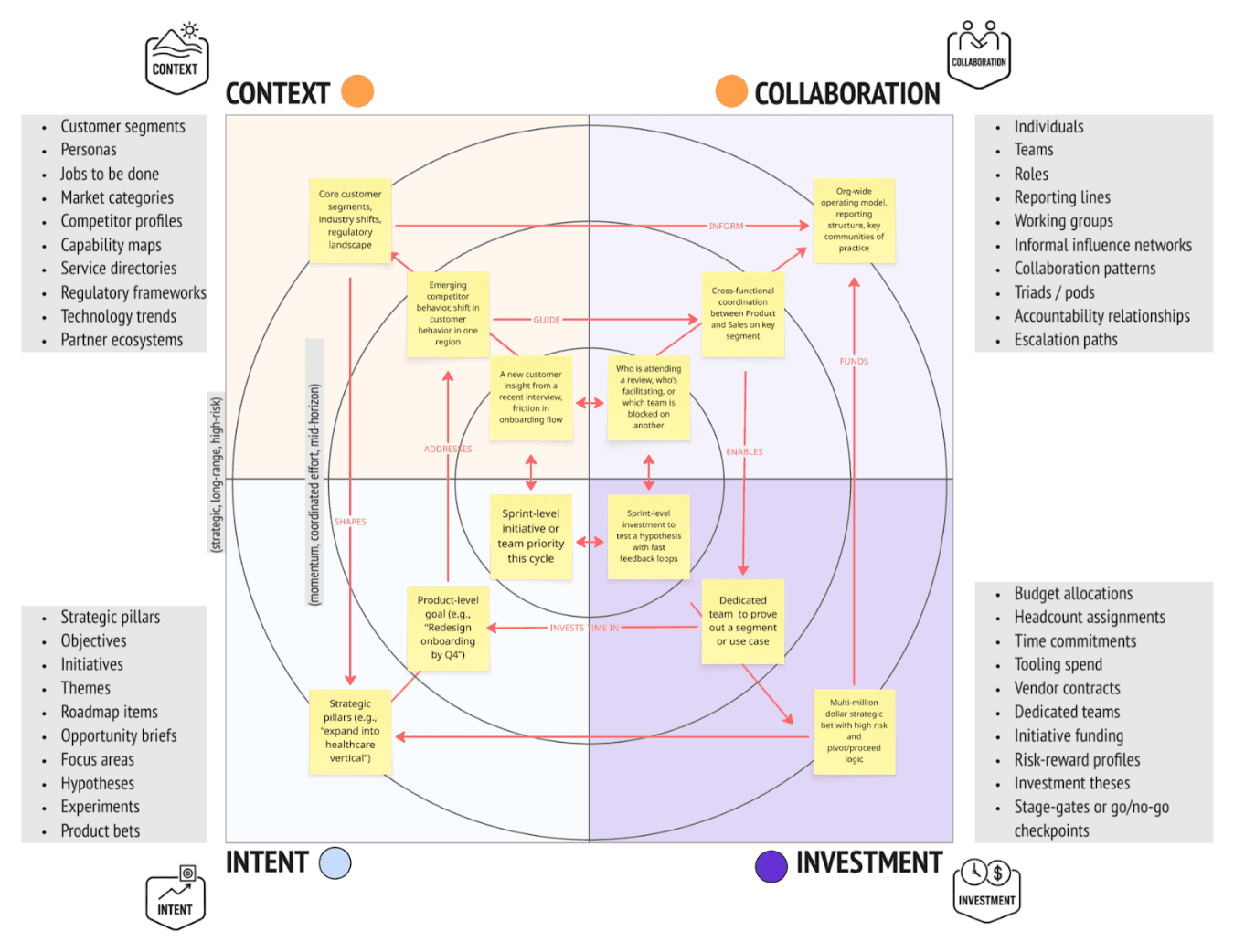
Reference: The 4 Graphs Model
A helpful framework we use internally is something we call the “4 Graphs” model. It considers the “nouns” and their relationships in four categories: Context, Intent, Collaboration, and Investment. As you consider your nouns and how they relate to each other, it might help to refer to this framework.
You're Done When
- You've created a list of nouns people actually use.
- You've merged obvious duplicates.
- You've captured meaning, usage, lifecycle, relationships, and health for each noun.
- You've identified areas where definitions are inconsistent or strategically ambiguous.
- You've compiled a noun spreadsheet that reflects real language.