Intent
The flow from signal to sustained impact
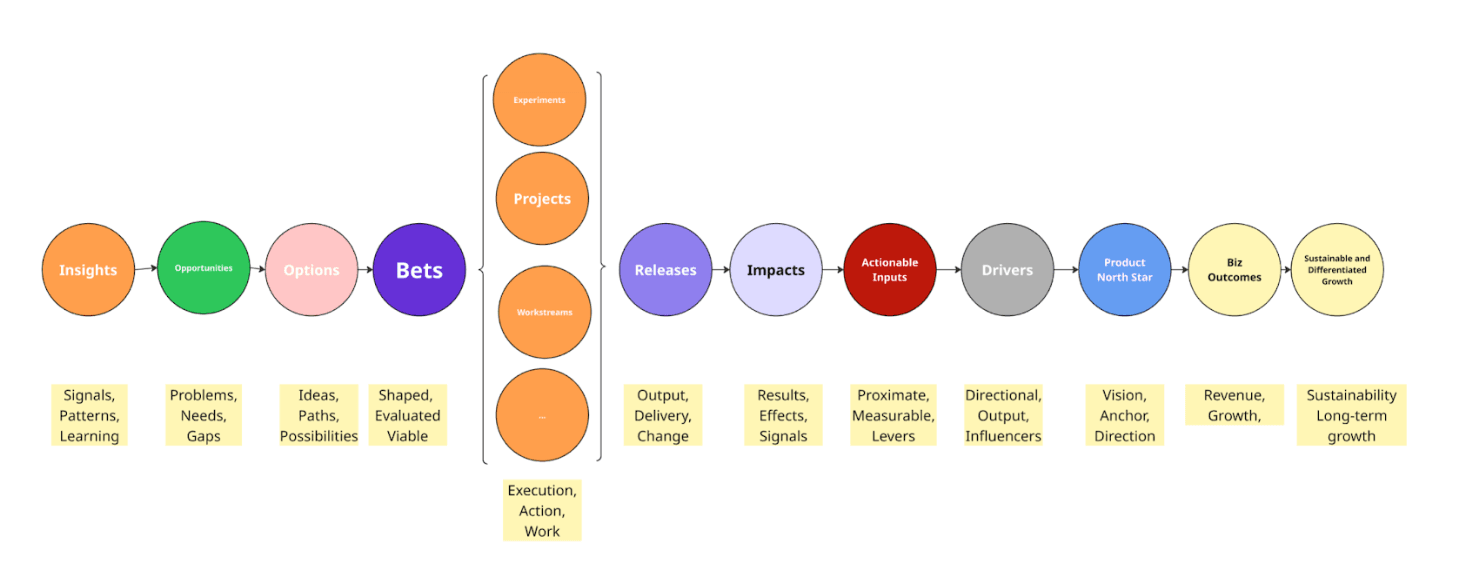
Product work tends to follow a fairly predictable path—though, of course, reality is rarely this neat. Still, it's helpful to have a shared, simplified model that captures the essential stages most product teams experience when moving from signal to sustained impact.
It starts with Insights—patterns, signals, or learnings that suggest something is worth exploring. These may emerge from user research, data anomalies, frontline observations, or market shifts.
Those insights shape our understanding of Opportunities—specific problems, needs, or gaps that we might pursue. Not every insight leads to an opportunity, but strong ones usually frame a real chance to deliver value.
From there, we consider Options—different ways we might approach those opportunities. Options are directional; they reflect ideas, paths, or possibilities without locking in execution yet.
Eventually, we transform one or more options into Bets—structured, evaluable commitments. A bet is a choice to invest in a particular approach. It includes a hypothesis, a learning or performance model, and a scope of time and effort. Importantly, bets vary in form: some are exploratory, others more delivery-focused.
That takes us into execution, where bets become work. This might look like:
- Experiments, where the focus is on learning fast
- Projects, with clearer outputs and coordination
- Workstreams, which are ongoing delivery tracks tied to larger initiatives
Once something is ready, we move to Release—a moment of delivery or deployment where something changes in the world.
We then look for Impacts—evidence of results, effects, or behavioral changes. These might be subtle or immediate, measurable or qualitative.
Impacts connect to a team's Actionable Inputs—proximate, measurable levers that the team actively tries to influence. These inputs reflect what the team believes it can control or improve in the short term.
Over time, those inputs contribute to Drivers—more directional or systemic outcomes that influence business performance. Drivers are often owned across teams or groups and are key inputs into a shared Product North Star.
That North Star, in turn, is a leading indicator of Business Outcomes—like revenue, retention, or engagement. And if all goes well—across time, teams, and layers of complexity—this chain of value creation ultimately contributes to sustainable and differentiated growth.
A Few Important Nuances
- This is not a linear funnel. Bets can fail and generate new insights. Drivers may shift unexpectedly and reframe your inputs. What looks like a short-term impact may later prove to be the root of a longer-term opportunity.
- Not all strategic opportunities live 1–3 years out. Some require immediate action. Not all tactical work is small or short. Some projects stretch across years. Time doesn't always correlate with scale or importance.
- This system embraces multiple altitudes of thinking:
- From what's possible (insights, options)
- To what's prioritized (bets)
- To what's being done (execution)
- To what's working (impacts, drivers, outcomes)
- It supports diverse work types. Not everything needs to be a project. Some things are questions. Some are nudges. Some are explorations. The structure doesn't mandate uniformity—it helps make complexity navigable.
This model serves as a backbone for how teams and organizations using the Starter Pack can design their decision-making rhythms, review rituals, and learning loops—and it grounds the system in a shared map of value creation from start to (ever-evolving) finish.
It is Fractal!
This diagram captures something essential: the flow from insight to impact isn't a one-time process. It's a fractal, layered system that plays out across multiple time horizons, with each level informing, shaping, and reinforcing the others.
Each opportunity, option, bet, and outcome is situated in time—whether that's 1–3 months, 1–3 quarters, or 1–3 years. But these layers don't exist in isolation. They're connected through nested hypotheses, evolving evidence, and cross-temporal feedback loops.
- A 1–3 year strategic opportunity may give rise to multiple 1–3 quarter bets.
- Each of those bets may inspire several short-term experiments or projects over 1–3 months.
- The results of those experiments feed back into impacts and actionable inputs, which in turn influence mid- and long-term drivers.
- Drivers inform how we understand the Product North Star, which is hypothesized to shape business outcomes and, ultimately, sustainable growth.
Importantly, this isn't a waterfall. It's a living system of interlinked loops—where outcomes shape new insights, bets create new options, and strategy gets sharpened by operations.
How the Starter Pack Supports This System
The Dotwork Starter Pack is designed to reflect and support this layered, graph-based model—not flatten it. Each element in the flow (from bets to business outcomes) is treated as a first-class object in the system and is fully graph-aware. That means you can nest, relate, and query across levels and timeframes.
| Capability | What It Supports |
|---|---|
| Graph-aware object relationships | Every Opportunity, Option, Bet, Input, or Driver is a unique object in Dotwork. They can be linked across time horizons, and nested within each other, allowing for clean modeling of layered strategy. |
| Impact-to-Input mapping | You can connect Impact objects directly to Actionable Inputs, letting teams reflect on whether their work is actually influencing the levers they care about. |
| Nested timeframes | Opportunities and Drivers can be categorized and organized by 1–3 month, 1–3 quarter, or 1–3 year horizons, helping you create strategic clarity without collapsing everything into a flat roadmap. |
| Backlinking and context inheritance | Any object can reference another, and those links carry with them contextual metadata. For example, a short-term bet can be linked to a 3-year driver, and that relationship can be explored or visualized. |
| Integration with business metrics | You can map Impacts and Drivers to actual performance data, such as metrics coming from analytics tools or BI platforms, to validate learning loops in real time. |
| Insight lineage tracking | Track where a Bet came from—what Options were considered, what Opportunities sparked them, and what Insights informed the original decision. |
| Flexible object types and extensions | You can customize or extend objects (e.g., defining a new Bet type or Driver cluster), allowing your model to evolve with your company's maturity. |
Why This Matters
Most tools force you to choose between execution management or strategy planning. Dotwork makes it possible to hold both, in a connected system that recognizes that:
- Strategic work cascades into tactical action
- Tactical outcomes bubble back up into strategy
- Learning happens in loops—not ladders